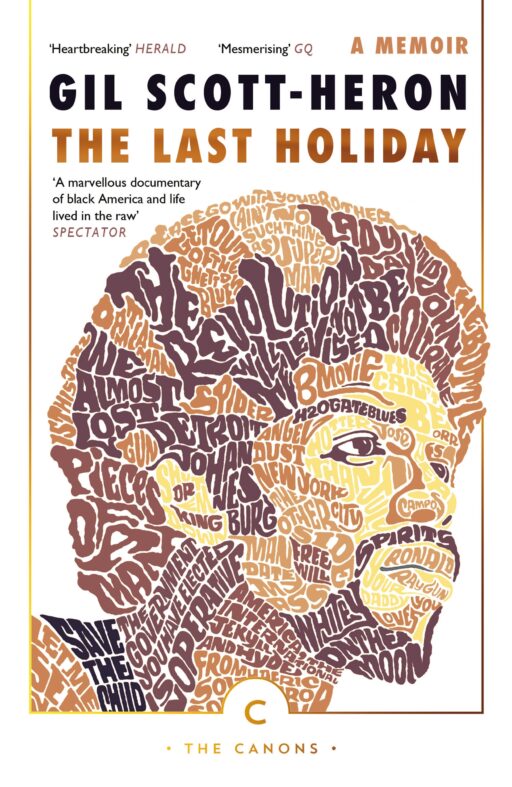
The Last Holiday A Memoir
- 18 May 2017
- 9781786890252
- £10.99
- 336 pp
- 129×198mm
- 12 Jan 2012
- 9780857863027
- £8.79
- 336 pp

In a few words
‘Leave it to Scott-Heron to save some of his best for last . . . He’s a real writer, a word man, and [The Last Holiday] is as wriggling and vital in its way as Bob Dylan’s Chronicles: Volume One’ New York Times
In a few words
‘Leave it to Scott-Heron to save some of his best for last. This posthumously published memoir is an elegiac culmination to his musical and literary career. He’s a real writer, a word man, and it is as wriggling and vital in its way as Bob Dylan’s Chronicles: Volume One.’ New York Times


A marvellous documentary of black America and life lived in the raw
Engaging and immensely human . . . Much like his poetry, Scott-Heron's style is spare and effective, offering up jagged observations on fame, friendship and political and racial injustice
Scott-Heron is such a fine writer . . . As readers and fans alike, we are left to mourn the passing of surely, the least likely pop star ever, one with a truly brilliant mind.
Rob Fitzpatrick
Sunday TimesThis memoir reads a bit like Langston Hughes filtered through the scratchy and electrified sensibilities of John Lee Hooker, Dick Gregory and Spike Lee . . . about his own music, he could not be more simple or elegant. "I was trying to get people who listened to me," he writes, "to realise that they were not alone."
Dwight Garner
New York TimesMore about
the book
Raised by his grandmother in Tennessee, Gil Scott-Heron’s journey from humble beginnings to becoming one of the most uncompromising and influential songwriters of his generation is a remarkable one. In this, his heartfelt, beautifully written and posthumously published memoir, we are given bright insights into the music industry, New York, the civil-rights movement, modern America, governmental hypocrisy, Stevie Wonder and our wider place in the world. It is also a fitting testament to the generous brilliance of Gil Scott-Heron and to the Spirits that guided him.
More about
the book
Raised by his grandmother in Tennessee, Gil Scott-Heron’s journey from humble beginnings to becoming one of the most uncompromising and influential songwriters of his generation is a remarkable one. In this, his heartfelt, beautifully written and posthumously published memoir, we are given bright insights into the music industry, New York, the civil-rights movement, modern America, governmental hypocrisy, Stevie Wonder and our wider place in the world. It is also a fitting testament to the generous brilliance of Gil Scott-Heron and to the Spirits that guided him.
This memoir reads a bit like Langston Hughes filtered through the scratchy and electrified sensibilities of John Lee Hooker, Dick Gregory and Spike Lee . . . about his own music, he could not be more simple or elegant. "I was trying to get people who listened to me," he writes, "to realise that they were not alone."
Dwight Garner
New York TimesOne of the great pioneers of late-twentieth-century music.
Scott-Heron is such a fine writer . . . As readers and fans alike, we are left to mourn the passing of surely, the least likely pop star ever, one with a truly brilliant mind.
Rob Fitzpatrick
Sunday TimesA delight, full of with and alliteration and studded with passages of verse . . . it is a heartbreaking read as the last testament of a much-loved man, but it should certainly be read.
Engaging and immensely human . . . Much like his poetry, Scott-Heron's style is spare and effective, offering up jagged observations on fame, friendship and political and racial injustice.
Fiona Sturges
Independent on SundayA delight, full of with and alliteration and studded with passages of verse . . . it is a heartbreaking read as the last testament of a much-loved man, but it should certainly be read.
An impressively lucid book . . . both candid and guarded . . . his final admissions are heart-rending.
Gil Scott-Heron is timeless.

Gil Scott-Heron
View profileIn a musical career spanning five decades, from Small Talk at 125th and Lenox to I’m New Here, Gil Scott-Heron (1949-2011) released twenty albums and many seminal singles including ‘The Revolution Will Not Be Televised,’ ‘Home Is Where the Hatred Is,’ ‘Winter in America,’ ‘B Movie,’ ‘Johannesburg,’ and ‘Lady Day and John Coltrane.’ He was also the author of three previous books: two novels, The Vulture and The Nigger Factory and Now and Then: The Poems of Gil Scott- Heron.
Gil Scott-Heron
View profileIn a musical career spanning five decades, from Small Talk at 125th and Lenox to I’m New Here, Gil Scott-Heron (1949-2011) released twenty albums and many seminal singles including ‘The Revolution Will Not Be Televised,’ ‘Home Is Where the Hatred Is,’ ‘Winter in America,’ ‘B Movie,’ ‘Johannesburg,’ and ‘Lady Day and John Coltrane.’ He was also the author of three previous books: two novels, The Vulture and The Nigger Factory and Now and Then: The Poems of Gil Scott- Heron.